
Local businesses need more than traffic.
They need qualified calls, form submissions, bookings, store visits, and revenue.
Google Ads and Meta Ads create demand and capture intent. Local SEO supports unpaid visibility. Analytics identifies which actions produce results.
This guide presents a weekly PPC and growth system for businesses in Venice, Florida, Sarasota County, and nearby service areas.
1. Build the measurement foundation
Do not optimize campaigns before tracking business outcomes.
Track primary conversions
Use one or two primary conversions for each campaign:
- Qualified phone calls
- Completed contact forms
- Appointment bookings
- Quote requests
- Online purchases
- Direction requests
- In-store visits, when measurable
Track secondary actions separately:
- Button clicks
- Email clicks
- Brochure downloads
- Service-page visits
- Video views
- Form starts
Connect:
- Google Ads
- Google Analytics 4
- Google Tag
- Customer relationship management software
- Call tracking
- Meta Pixel
- Meta Conversions API
Google Ads uses conversion data for bidding. Meta uses event data for optimization and measurement. Meta states that Conversions API creates a direct connection between business data and its advertising systems.
Import qualified leads and closed sales when possible. A form submission does not equal revenue. Your CRM should identify which leads become customers.
Assign conversion values
Use different values for different actions.
Example:
- Qualified service call: $150
- Consultation booking: $250
- Online purchase: actual order value
- Unqualified form: $0
- Newsletter signup: secondary conversion
This gives bidding systems better data.
Review Google Business Profile performance insights and paid campaign data together. The combination shows how customers find and contact the business.
2. Prepare the local conversion path
Paid traffic exposes weak websites.
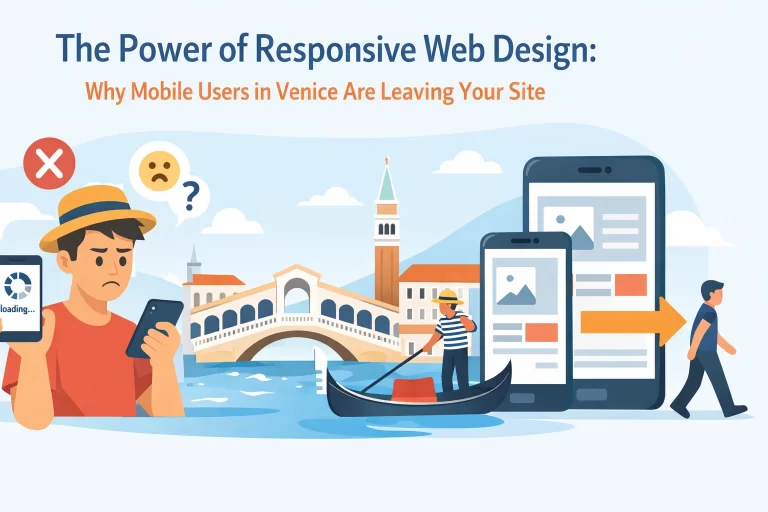
The landing page must work on mobile devices, load quickly, and match the ad.
Use a mobile-friendly website with:
- One clear page purpose
- Visible phone number
- Click-to-call button
- Short contact form
- Service details above the fold
- Local address or service area
- Reviews or customer proof
- Clear operating hours
- Strong call to action
A responsive web design Venice FL strategy must support every screen size. Test the page on phones, tablets, and desktop screens.
Check:
- Page load speed
- Form completion
- Button spacing
- Text legibility
- Map and address accuracy
- Mobile menu operation
- Call tracking
Review the company’s website speed recommendations before increasing ad spend.
A slow page raises the cost of every click.

3. Optimize Google Business Profile and local search
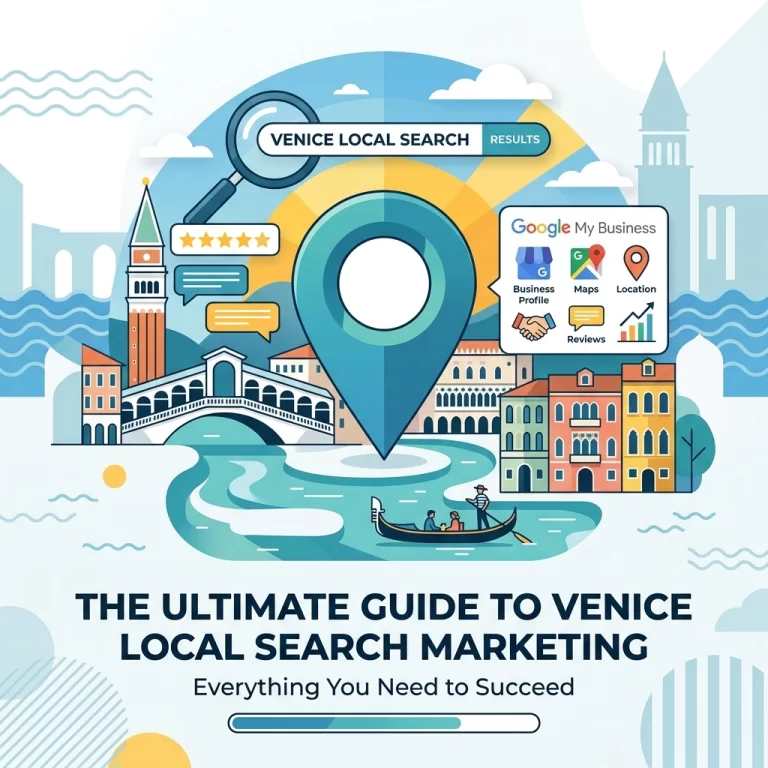
PPC does not replace local search marketing Venice FL efforts.
A complete Google Business Profile supports paid, organic, and map visibility.
Weekly Google Business Profile checklist
- Confirm business hours.
- Confirm phone number.
- Confirm address and service areas.
- Review primary and secondary categories.
- Add new photos.
- Publish one useful update.
- Respond to every review.
- Check calls, messages, website clicks, and direction requests.
- Add UTM parameters to the website link.
Google states that local ranking depends mainly on relevance, distance, and prominence. Complete information improves relevance. Reviews and local links support prominence.
Use accurate business information. Do not add keywords to the business name unless they are part of the real name.
Maintain local citations
Audit local citations Venice Florida businesses rely on:
- Venice Area Chamber of Commerce
- Better Business Bureau
- Yelp
- Bing Places
- Industry directories
- Local news websites
- Community organizations
Keep the business name, address, and phone number consistent.
Connect PPC data with local SEO data. Compare paid leads, map interactions, organic leads, and calls by location.
Use the company’s Venice local search marketing guide for a complete local visibility checklist.
4. Week 1: Structure Google Ads by intent
Start with search demand.
Create separate campaigns for different objectives:
- High-intent service searches
- Brand searches
- Emergency or urgent searches
- Location-specific services
- Remarketing, when audience volume supports it
Use ad groups with closely related terms.
Example for a Venice plumber:
- Plumber Venice FL
- Emergency plumber Venice
- Water heater repair Venice
- Drain cleaning near me
Create separate landing pages for major services. Match the keyword, ad, and page.
Apply local targeting
Set the campaign location to:
- Venice
- Nokomis
- Englewood
- North Port
- Sarasota
- Approved service areas
Use the location option that targets people physically present in the selected areas when the business serves local customers.
Exclude locations outside the service area.
Set ad schedules based on staffing. Do not run call campaigns when nobody answers the phone.
Build negative keyword controls
Review search terms each week.
Add negative keywords such as:
- Jobs
- Careers
- Free
- Training
- DIY
- Wholesale
- Used
- Tutorial
Add industry-specific negatives. A medical practice may exclude “school.” A home service company may exclude “parts” or “manual.”
Search term review protects budget and improves lead quality.
5. Week 2: Improve Google Ads bidding and assets
Use manual controls while data remains limited.
Use:
- Maximize Clicks for limited early testing
- Maximize Conversions after reliable conversion tracking
- Target CPA after sufficient conversion volume
- Maximize Conversion Value for revenue-based campaigns
- Target ROAS when revenue data is reliable
Do not change bidding strategies every few days. Allow the campaign to collect usable data.
Increase budgets gradually. Use 10% to 20% changes instead of large adjustments.
Build stronger ad assets
Create Responsive Search Ads with:
- Service keywords
- Venice or service-area references
- Clear benefits
- Proof points
- Operating hours
- Calls to action
- Call extensions
- Location assets
- Sitelinks
- Structured snippets
Test different messages:
- Price-focused
- Speed-focused
- Trust-focused
- Convenience-focused
- Local expertise-focused
Example:
Test A: Same-Day AC Repair in Venice
Test B: Licensed AC Technicians Serving Venice
Test C: Book Venice AC Repair Today
Keep the landing page aligned with the message.
Use Google Ads official guidance for account, conversion, and campaign configuration.
6. Week 3: Add Meta Ads to create and recover demand
Google captures active intent.
Meta creates awareness and supports follow-up.
Use Meta for:
- Local awareness
- Lead forms
- Website leads
- Offer promotion
- Customer reactivation
- Website remarketing
- Video engagement
- Testimonial distribution
Build local audiences
Use:
- Tight geographic radius
- Service-area targeting
- Website visitors
- Customer lists
- Existing leads
- Video viewers
- Social media engagers
- Lookalikes based on qualified customers
Do not build lookalikes from every lead. Use closed customers or qualified leads when the list is large enough.
Test creative formats
Create separate ads for:
- Static image
- Short video
- Carousel
- Customer testimonial
- Before-and-after result
- Offer graphic
- Staff or location introduction
Test one variable at a time.
Example:
- Same audience and offer
- Different opening image
- Same landing page
- Same budget
- Same campaign period
Use a direct CTA:
- Call now
- Book today
- Get directions
- Request a quote
- Schedule service
Implement the Meta Conversions API alongside the Meta Pixel when possible. Connect website, CRM, phone, and offline events.
7. Week 4: Launch remarketing and growth tactics
Most visitors do not convert on the first visit.
Create remarketing segments by action:
- Viewed a service page
- Started but did not submit a form
- Visited the contact page
- Watched 50% of a video
- Called but did not book
- Purchased within the last 30 days
- Purchased more than 90 days ago
Use different messages for each group.
Example:
- Service-page visitor: repeat the service benefit.
- Form abandoner: simplify the next step.
- Past customer: promote maintenance or an additional service.
- Video viewer: show proof and a booking CTA.
Use growth tactics beyond advertising
Test:
- Referral campaigns
- Review requests after completed jobs
- Seasonal service packages
- Existing-customer email campaigns
- Local partnerships
- Community sponsorships
- Service-area landing pages
- Customer reactivation campaigns
- Cross-selling between related services
Connect every campaign to a trackable URL or code.
Growth depends on repeatable systems. Do not rely on one channel.

8. Establish a weekly analytics routine
Use the same report every week.
Review acquisition metrics
- Impressions
- Click-through rate
- Cost per click
- Search impression share
- Reach
- Frequency
- Landing-page views
Review conversion metrics
- Conversion rate
- Cost per lead
- Cost per qualified lead
- Call answer rate
- Booking rate
- Lead-to-customer rate
- Revenue
- Return on ad spend
- Blended customer acquisition cost
Review local metrics
- Leads by city
- Calls by ZIP code
- Revenue by service area
- Google Business Profile calls
- Direction requests
- Organic local traffic
- Review volume
- Citation accuracy
Compare platform data with CRM data.
If Google reports 30 leads but the CRM shows five qualified leads, the campaign needs a quality review. Check search terms, forms, locations, and call recordings.
Weekly action sequence
- Confirm tracking works.
- Compare results with targets.
- Review search terms.
- Add negative keywords.
- Review location performance.
- Pause clear underperformers.
- Check landing-page behavior.
- Review Meta frequency and creative fatigue.
- Select one test.
- Document the change.
Do not make undocumented changes.

9. Use controlled A/B testing
Testing requires a defined question.
Weak test:
Change the ad and see what happens.
Strong test:
Does a “Book Today” CTA produce more qualified calls than a “Get a Quote” CTA for Venice service searches?
Test one variable
Test:
- Headline
- Call to action
- Offer
- Form length
- Landing-page layout
- Review placement
- Image
- Video opening
- Audience
- Bid strategy
- Service-area radius
Keep the other settings stable.
Define:
- Primary metric
- Test duration
- Budget
- Minimum conversion volume
- Winning threshold
- Follow-up action
Do not declare a winner from a few clicks. Review conversion volume, lead quality, and revenue.
Use Google Ads experiments for bidding and campaign changes. Use Meta’s testing tools for audience and creative comparisons.
Record the result:
- Test name
- Hypothesis
- Start date
- End date
- Traffic allocation
- Result
- Decision
Build a testing archive. Repeated learning improves performance.
10. Apply the 90-day growth roadmap
Days 1–30: Fix the foundation
- Audit tracking.
- Configure GA4.
- Set primary conversions.
- Improve the mobile experience.
- Optimize Google Business Profile.
- Correct local citations.
- Build high-intent Search campaigns.
- Create service-specific landing pages.
Days 31–60: Improve efficiency
- Review search terms weekly.
- Add negative keywords.
- Test ad messages.
- Adjust location targeting.
- Launch Meta remarketing.
- Add customer and CRM data.
- Review qualified lead cost.
Days 61–90: Scale validated campaigns
- Increase winning budgets gradually.
- Launch Performance Max when conversion data supports it.
- Add Meta lookalikes based on qualified customers.
- Test new service areas.
- Compare city-level revenue.
- Import offline sales.
- Stop campaigns that fail quality targets.
Use SEO and AEO services to support paid visibility with stronger organic search performance.
Final operating standard
Advanced PPC is a measurement process.
The process is:
- Define the business outcome.
- Track the outcome.
- Match ads to local intent.
- Send traffic to a responsive page.
- Review data weekly.
- Test one change.
- Improve lead quality.
- Scale only validated results.
Businesses that need support with Venice Florida web design tips, paid advertising, SEO, or local search marketing can contact Venice Florida Web Design.