
Paid advertising produces traffic quickly.
It does not guarantee growth.
Local businesses need four connected systems:
- Accurate targeting
- Conversion-ready landing pages
- Reliable tracking
- Weekly optimization
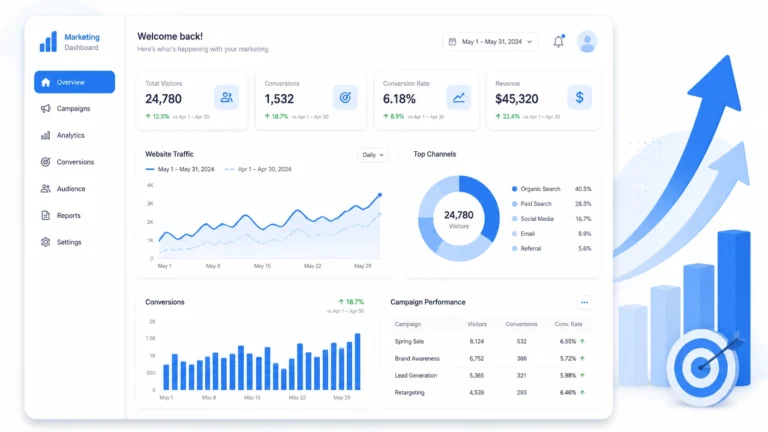
Google Ads captures active demand. Meta Ads creates demand and supports retargeting. Analytics connects advertising activity to calls, bookings, visits, and revenue.
This guide presents a practical PPC framework for Venice restaurants, retailers, service providers, medical practices, law firms, and real estate professionals.
1. Build the Local PPC Foundation
Start with the business outcome.
Do not optimize for clicks if the goal is booked appointments. Do not optimize for form submissions if most submissions are unqualified.
Define the primary conversion
Choose one or two actions for campaign bidding:
- Completed appointment
- Qualified lead form
- Phone call lasting more than 30 or 60 seconds
- Online purchase
- Property inquiry
- Reservation request
Track other actions as secondary conversions:
- Map clicks
- Menu views
- Directions requests
- Chat starts
- Brochure downloads
- Time on key pages
Use Google Ads conversion tracking and connect it to GA4. Import qualified and closed leads from your CRM when possible.
Calculate the acceptable cost per lead
Use this formula:
Maximum cost per lead =
Average customer revenue × Gross margin × Close rate
Example:
- Average legal case value: $4,000
- Gross margin: 50%
- Lead-to-client close rate: 20%
$4,000 × 0.50 × 0.20 = $400 maximum cost per qualified lead
This value gives the campaign a business-based target.
2. Connect PPC with Local Search
Paid advertising performs better when the local presence is complete.
Before increasing ad spend, review:
- Google Business Profile categories
- Business name, address, and phone consistency
- Service descriptions
- Review volume and response rate
- Local landing pages
- Local citations
- Mobile page speed
- Call and form usability
Effective Google Business Profile optimization in Venice supports both organic visibility and paid campaign credibility.
Consistent local citations in Venice, Florida also reduce location confusion across search platforms.
Use the same information on:
- Google Business Profile
- Apple Business Connect
- Bing Places
- Yelp
- Chamber directories
- Industry directories
- Local association websites
PPC does not replace Venice Florida local SEO. It supports the entire local search system.
3. Structure Google Ads by Intent
Separate campaigns by customer intent.
Campaign 1: Brand Search
Target searches for the business name.
Use this campaign to:
- Protect branded traffic
- Control the search message
- Direct users to a specific offer
- Track branded demand
- Prevent competitors from occupying the top position
Campaign 2: High-Intent Service Search
Target searches that show immediate demand.
Examples:
- “Venice FL personal injury lawyer”
- “dentist near me”
- “Venice Florida emergency plumber”
- “best Italian restaurant Venice FL”
- “homes for sale in Venice Florida”
- “medical clinic near Venice”
Create separate ad groups or campaigns for major service categories.
Each group needs:
- Matching keywords
- Relevant ad copy
- One focused landing page
- A clear conversion action
Campaign 3: Non-Brand Discovery
Use Performance Max, Demand Gen, or other discovery campaigns after conversion tracking produces reliable data.
Provide:
- Accurate service categories
- Location signals
- High-quality photos
- Short videos
- Customer reviews
- Offers
- First-party audience signals
Do not combine every service into one asset group. A restaurant promotion, law consultation, and medical appointment require different messages.
Add negative keywords weekly
Review search terms every week.
Exclude terms such as:
- Free
- Jobs
- Training
- Course
- DIY
- Used
- Template
- Wholesale
- Out of area locations
- Services the business does not provide
Negative keywords reduce wasted spend and improve search intent.
4. Use Local Targeting with Control
Set location targeting around the actual service area.
For a Venice business, test:
- Venice
- Nokomis
- Osprey
- Englewood
- North Port
- Sarasota
- Specific ZIP codes
- A radius around the office or store
Separate service areas when performance differs.
Example:
A home service company may receive strong leads within 10 miles but poor leads from a 30-mile radius. Create separate geographic campaigns. Assign each campaign its own budget and target.
Review location reports weekly.
Check:
- Clicks by city
- Conversion rate by ZIP code
- Cost per qualified lead
- Call quality by location
- Revenue by service area
Reduce spend in areas that generate clicks but no customers.
5. Improve the Landing Page Before Increasing Spend
A paid click must reach a page that supports the advertised action.
Use a dedicated landing page for each major campaign.
The page should include:
- Service and location in the headline
- One primary call to action
- Click-to-call phone number
- Short form
- Trust indicators
- Reviews or testimonials
- Service area
- Operating hours
- Directions or location details
- Clear next step
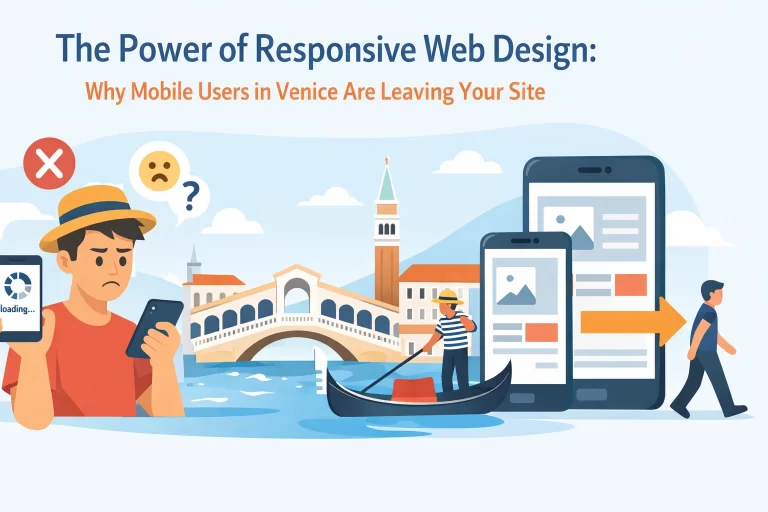
A mobile-friendly website in Venice is essential for local PPC. Many local users search from phones and act immediately.
Test page versions such as:
- Form above the fold versus below the service details
- “Book an Appointment” versus “Request a Callback”
- Review section near the form versus near the footer
- Short form versus multi-step form
- Discount offer versus free consultation
Use responsive web design in Venice, FL to keep the page functional across phones, tablets, and desktops.
6. Use Meta Ads to Create and Recover Demand
Google captures people who search. Meta reaches people before they search.
Use Meta for:
- New customer awareness
- Seasonal offers
- Local events
- Product launches
- Educational content
- Retargeting
- Customer list campaigns
- Appointment and lead campaigns
Basic campaign structure
Prospecting campaign
Target a broad local audience.
Use:
- Venice and surrounding locations
- Appropriate age ranges
- Broad targeting where conversion data supports it
- New customer exclusions
- Local images and video
Retargeting campaign
Reach users who:
- Visited the website
- Viewed a service page
- Watched a video
- Engaged with Instagram
- Opened a lead form
- Started but did not complete a booking
Use a different message.
Example:
First visit: Schedule your Venice dental consultation.
Retargeting: Still comparing options? Review services and request a callback.
Offer campaign
Promote a specific action:
- Restaurant weekday special
- Retail event
- Medical consultation
- Real estate open house
- Legal case evaluation
- Home service inspection
Use an expiration date only when it reflects a real deadline.
Install reliable tracking
Use the Meta Pixel with Meta Conversions API.
Track:
- Lead
- Complete registration
- Appointment
- Purchase
- Phone click
- Contact form
- Offline sale
Meta states that Conversions API creates a direct connection between business data and its optimization systems. This supports measurement across website, CRM, phone, and offline events.
Use UTMs on every ad:
utm_source=facebook
utm_medium=paid_social
utm_campaign=venice_consultation
utm_content=video_hook_a
7. Run One Controlled Test Each Week
Do not change every setting at once.
A controlled test isolates one variable.
Google Ads test examples
Test:
- “Call Now” versus “Request a Quote”
- Service benefit versus price offer
- City name in headline versus customer outcome
- One landing page layout versus another
- Maximize Conversions versus Target CPA
- Exact and phrase match structure versus broader matching
Google describes Target CPA bidding as an automated strategy that adjusts bids based on the likelihood of conversion.
Do not set a target CPA below the business’s acceptable cost. A low target can restrict traffic and reduce total conversions.
Meta test examples
Test:
- Testimonial video versus service demonstration
- Local staff member versus product image
- Offer in the first three seconds versus offer in the caption
- Reels placement versus Feed placement
- Lead form versus landing page
- Free consultation versus limited-time promotion
Testing rules
- Define one hypothesis.
- Select one primary metric.
- Keep the audience and budget stable.
- Run the test for a meaningful period.
- Record the result.
- Apply the winning change.
- Start the next test.
Do not judge a test from a few clicks. Compare results after enough impressions and conversions accumulate.
8. Create a Weekly PPC Operating System
Use the same review process every week.
Monday: Tracking review
Check:
- Google Ads conversion tags
- GA4 events
- Meta Pixel events
- Conversions API events
- Phone tracking
- CRM lead imports
- Duplicate conversions
- Broken forms
A tracking error can make a successful campaign appear ineffective.
Tuesday: Search term review
Check:
- Irrelevant searches
- New customer language
- High-converting phrases
- Geographic patterns
- Negative keyword opportunities
Add useful search terms to ad groups or landing page copy.
Wednesday: Creative review
Check:
- Ad fatigue
- Low engagement
- Poor hooks
- Weak calls to action
- Asset group performance
- Placement results
Replace weak creative. Keep proven messages active.
Thursday: Conversion review
Compare:
- Cost per lead
- Qualified lead rate
- Booking rate
- Call duration
- Close rate
- Revenue by campaign
A low-cost lead is not valuable if the sales team cannot close it.
Friday: Budget review
Move budget toward campaigns that meet business targets.
Increase budgets gradually. Large changes can disrupt automated bidding and make performance harder to evaluate.
Record each change in a testing log:
Date:
Campaign:
Change:
Reason:
Expected result:
Actual result:
Next action:
9. Use a Simple Growth Dashboard
Build one weekly report for Google Ads, Meta Ads, organic search, and the CRM.
Track:
| Metric | Purpose |
|---|---|
| Spend | Controls budget |
| Impressions | Measures reach |
| Click-through rate | Measures message relevance |
| Cost per click | Measures auction cost |
| Conversion rate | Measures page and offer performance |
| Cost per qualified lead | Measures lead efficiency |
| Close rate | Measures lead quality |
| Revenue | Measures business impact |
| Return on ad spend | Measures financial return |
Use platform data for campaign management. Use CRM and accounting data for final decisions.
This prevents a common error: scaling a campaign because it produces many form fills while actual sales remain flat.
10. 60-Day Implementation Plan
Weeks 1–2: Audit and setup
- Define revenue goals.
- Calculate acceptable CPA.
- Audit Google Business Profile.
- Review local citations.
- Verify service areas.
- Install Google and Meta tracking.
- Connect GA4 and CRM.
- Check the mobile experience.
Weeks 3–4: Launch
- Create brand and service Search campaigns.
- Build focused landing pages.
- Launch Meta prospecting and retargeting.
- Add location assets.
- Add negative keywords.
- Confirm every conversion.
Weeks 5–6: Analyze
- Review search terms.
- Compare locations.
- Evaluate lead quality.
- Test ad copy.
- Test one landing page element.
- Remove obvious waste.
Weeks 7–8: Scale
- Increase budget on profitable campaigns.
- Import offline sales data.
- Test value-based bidding.
- Expand winning service areas.
- Add new creative based on customer language.
- Document the next testing cycle.
Final Checklist
Before increasing PPC spend, confirm that the business has:
- A clear conversion goal
- A defined acceptable CPA
- Accurate conversion tracking
- A mobile-friendly website
- Dedicated landing pages
- Optimized Google Business Profile
- Consistent local citations
- Negative keyword controls
- Meta Pixel and Conversions API
- CRM lead quality reporting
- A weekly testing schedule
Paid advertising works best as part of a complete local growth system.
Use Google Ads to capture demand. Use Meta to build and recover demand. Use responsive design to remove conversion barriers. Use local search marketing in Venice, FL to strengthen visibility across paid and organic channels.
For additional Venice Florida web design tips or a campaign and website review, contact Venice Florida Web Design.