
Strategic Framework
Local business growth in 2026 requires data-driven precision. Standard broad-match campaigns create budget waste. Advanced Pay-Per-Click (PPC) strategies prioritize high-intent traffic within specific geographic corridors. This guide outlines technical implementations for Venice, Florida businesses.
Infrastructure: Conversion Tracking
Effective growth relies on accurate data ingestion. Systemic tracking captures user interactions across all touchpoints.
- Action: Install Google Tag Manager (GTM) on Venice Florida Web Design sites.
- Action: Deploy server-side tagging to bypass browser tracking limitations.
- Action: Configure phone call tracking via dynamic number insertion (DNI).
- Action: Link Google Ads and Google Analytics 4 (GA4) properties.
- Action: Set up "Enhanced Conversions" to capture first-party data.

Geographic Targeting: Hyper-Local Precision
Venice, Florida has distinct demographic zones. Targeting requires geographic isolation.
1. Presence-Based Targeting
- Select "Presence" in location settings.
- Exclude "Interest" to prevent out-of-state budget drain.
- Isolate target ZIP codes: 34284, 34285, 34292, 34293.
2. Radius & Geofencing
- Implement 5-mile radius around physical storefronts.
- Apply bid modifiers for affluent zones (e.g., Venice Island, South Venice).
- Increase bids (+25%) for users within 2 miles of high-value landmarks.
3. Location Exclusion
- Exclude neighboring cities (Sarasota, North Port) if service area is limited.
- Monitor "User Location" reports weekly.
- Add negative locations for low-performing neighborhoods.
Intent-Based Campaign Architecture
Structure campaigns by user intent levels. Avoid mixing broad research terms with high-intent "near me" queries.
Pillar 1: High-Intent Search
- Keywords: [Service] + [City], [Service] + "Near Me".
- Strategy: Exact match only.
- Goal: Direct conversion.
Pillar 2: Broad Discovery
- Keywords: Solution-oriented phrases without location modifiers.
- Strategy: Phrase match with tight negative lists.
- Goal: New keyword identification.
Pillar 3: Branded Defense
- Keywords: Business name, owner names.
- Strategy: Maximize Impression Share.
- Goal: Protect market share from competitors.
Pillar 4: Competitor Conquesting
- Keywords: Competitor brand names.
- Strategy: Target outranking share.
- Goal: Capture traffic from established local rivals.

Platform Execution: Google Ads vs. Meta
Different platforms serve different stages of the customer journey.
Google Ads: The "Pull" Strategy
- Search Ads: Capture active demand for specific services.
- Local Services Ads (LSAs): Utilize for Google Screened/Guaranteed leads.
- Performance Max: Deploy only with robust conversion data (30+ conversions/month).
Meta Ads: The "Push" Strategy
- Targeting: Interest-based (Homeowners, Golf Enthusiasts, Retirees).
- Ad Formats: Reels for brand awareness; Lead Forms for direct acquisition.
- Creative: High-contrast images of local Venice landmarks to build trust.
Seasonal Optimization & Scheduling
Florida business cycles fluctuate. Adjust PPC parameters to match local behavior.
Snowbird Season (October – April)
- Increase budgets for healthcare and home services.
- Update ad copy to emphasize "Seasonal Resident Specials."
- Adjust bid modifiers for high-income retirement communities.
Hurricane Season (June – November)
- Prepare "Emergency Response" campaigns for roofing and restoration.
- Schedule ads to run 24/7 during weather alerts.
- Enable click-to-call extensions prominently.
Time-of-Day Adjustments
- Home Services: Peak bids 7:00 AM – 11:00 AM.
- Restaurants/Retail: Peak bids 4:00 PM – 8:00 PM.
- Medical: Peak bids 8:00 AM – 3:00 PM.
High-Converting Creative Assets
Creative must align with the local Venice context. Use visual cues that resonate with the community.
- Localization: Reference "Downtown Venice" or "Venice Beach" in headlines.
- Social Proof: Feature testimonials from customers in Nokomis or Osprey.
- Clarity: Use bold, legible fonts for mobile viewing.
- Navigation: Direct users to Portfolio Examples for design inspiration.

A/B Testing & Data Refinement
Continuous testing identifies the highest ROI configurations. Implement systematic experiments.
1. Headline Testing
- Test A: Benefit-driven (e.g., "Save 20% on Roof Repair").
- Test B: Local-driven (e.g., "Venice's #1 Rated Roofer").
2. Landing Page Variation
- Test A: Short lead form with few fields.
- Test B: Multi-step form with qualifying questions.
3. Bidding Strategy Experiment
- Test A: Maximize Conversions.
- Test B: Target CPA (Cost Per Acquisition).
90-Day Implementation Roadmap
Follow this schedule to scale local operations.
Month 1: Foundation
- Audit existing campaigns.
- Verify tracking accuracy in GA4.
- Standardize NAP (Name, Address, Phone) across platforms.
- Build negative keyword list of 500+ terms.
Month 2: Optimization
- Launch localized landing pages.
- Enable ad extensions (Location, Call, Sitelinks).
- Review search term reports daily.
- Move high-performing broad terms to exact match.
Month 3: Scaling
- Apply Target ROAS bidding to established campaigns.
- Expand reach to secondary service areas (Englewood, Laurel).
- Launch remarketing campaigns for non-converters.
- Review quarterly ROI and reallocate budget to top performers.
Technical Maintenance Checklist
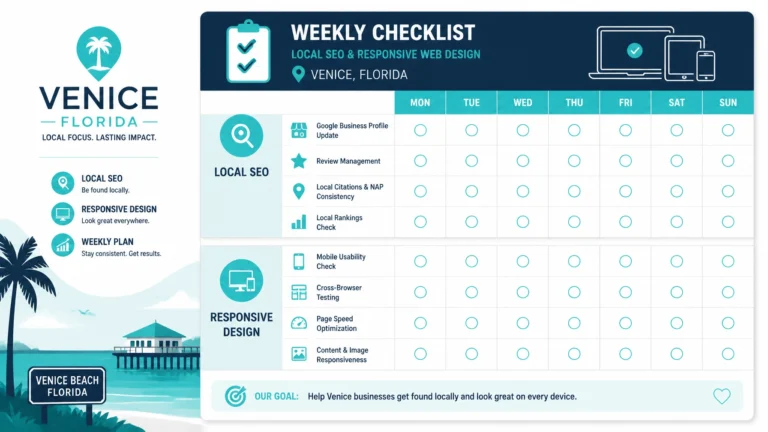
Perform these actions regularly to maintain campaign health.
| Frequency | Task | Objective |
|---|---|---|
| Daily | Budget Check | Prevent overspending / Identify caps |
| Weekly | Search Term Audit | Add negative keywords / Find new trends |
| Bi-Weekly | Ad Copy Review | Replace lowest performing 10% |
| Monthly | Location Analysis | Shift budget to high-ROI ZIP codes |
| Quarterly | Strategy Pivot | Align with Florida seasonality |
Advanced Measurement Metrics
Shift focus from clicks to revenue-driving data.
- Cost Per Acquisition (CPA): Total spend / Total leads.
- Lead Quality Score: Percentage of leads that become customers.
- ROAS (Return on Ad Spend): Revenue / Ad Spend.
- LTV (Lifetime Value): Projected revenue from a single PPC lead over time.
Continuous Growth
Scaling a local business requires persistent data analysis. Contact our team at Venice Florida Web Design for a comprehensive PPC audit. We specialize in responsive web design and data-driven marketing strategies for the Southwest Florida region.